
Secure cloud data processing
Signal ingestion, valid-window selection, and phenotype inference run in an isolated, access-controlled cloud environment. Compute is separated from identity, so analysis never requires the raw identity of the subject.
Neurosymbolic biometric intelligence (NBI)™
SaluTests is not about one more wearable.
It is an intelligence layer for physiological data backed by our proprietary NBI™ engine.
We turn raw wearable signals into an individual physiological model. Every reading is judged as an individual physiological digital twin — a computational representation of a person's dynamic hemodynamic state ( personalized hemodynamic phenotype), not deviation from a statistical average of strangers.
HIPAA & GDPR-aligned processing · encrypted end to end
How it works
Most systems destroy the very information they are meant to measure. SaluTests is built the other way around — to preserve the waveform, then reason over it.
Our trusted & valid windows algorithms scan the raw recording at different stages (locally and in the cloud) and keep only the intervals that are physiologically trustworthy — clean, artifact-free beats with reproducible wave morphology.
Unlike other platforms, we do NOT use destructive filtration that kills pulse wave morphology. Nothing is smoothed, band-passed, or averaged away: the physiologically informative morphology of every pulse beat survives intact.
Each retained beat is decomposed into its contour landmarks — upstroke kinetics, systolic peak, dicrotic notch, decay slope — and mapped to an individual hemodynamic phenotype rather than a population percentile.
Our SaluTests NBI™ engine cross-checks the heart, the vessels, and blood volume against one another. Concordant findings confirm the phenotype; discordance is surfaced as a signal in its own right, not discarded as noise.
Health resilience, functional reserves, and emerging risks are quantified, then compiled into an automated recommendations report — reasoned, traceable, and written in physiological or coaching language depending on the selected mode.
The phenotype does not prescribe a treatment; it characterises the physiological configuration that can be considered when selecting and evaluating an intervention.
Technology & security
Premium health infrastructure is judged on what it refuses to do carelessly. Our architecture treats confidentiality, integrity, and explainability as design constraints.
Signal ingestion, valid-window selection, and phenotype inference run in an isolated, access-controlled cloud environment. Compute is separated from identity, so analysis never requires the raw identity of the subject.
Every recording is encrypted the moment it leaves the device and stays encrypted in storage. Keys are managed independently of the data they protect, with strict rotation and least-privilege access.
Data minimisation, lawful basis, subject access, and deletion workflows are designed in — not bolted on. Processing agreements and audit trails accompany every deployment.
Because the engine is neurosymbolic, each conclusion carries the explicit rules and measurements it rests on. Every report can be re-derived and reviewed by a clinician.
PPG-derived cardiovascular dynamics mapped continuously down to raw wave morphology.
Evaluated through orthostatic, respiratory, hydration, and other standardized physiological challenges.
Quantifying exactly how a specific person's regulatory feedback systems differ from abstract population averages.
Demonstrating how apparently similar clinical or healthy states can emerge from completely different underlying regulatory configurations.
Verifying whether phenotype-guided interventions produce highly differentiated, predictable physiological responses.
Founder & Chief Scientific Director

M.D., Ph.D., D.Sc. — Founder & Chief Scientific Director
Google Scholar publicationsVerify SciRank RegistryPeer-reviewed record, citations & co-authors
“Population-derived normal ranges measure statistical deviations, not your physiological health. Phenotyping measures your true health resilience and adaptation capacities.”
Directs the scientific programme behind neurosymbolic hemodynamic phenotyping — from trusted & valid window signal theory through to automated physiological and health recommendation logic.
Officially ranked among the top 5% of active scientists worldwide (Global Registry rank #990,159), recognizing decades of high-impact contributions to global physiological and hemodynamic research.
The development of the core scientific framework underlying our technology was accelerated thanks to the support from the "María Zambrano" grant modality (NextGenerationEU funding).
Decades of peer-reviewed work on hemodynamic regulation, pain and cardiovascular physiology, individual differences, and the interaction between autonomic control and health resilience.
Long-standing critic of population-based normal ranges; developed methodological approaches that establish each person as their own physiological reference, quantifying body and mind working reserves rather than deviations from a group mean.
Extensive international collaboration across physiology, biomedical engineering, and computational modelling, with a publication record spanning experimental studies, reviews, and methodological contributions.
Chief Medical Officer
“Advanced biomarkers achieve nothing if isolated from the lived organism. True physiological resilience is mapped under load, where active autonomic reflexes and fluid shifts distinguish systemic capacity from marketing illusions.”
Leads clinical and scientific validation pathways, translating NBI-based phenotyping into clinically meaningful, actionable, and patient-centered insights.
Specializes in autonomic nervous system (ANS) dynamics, interoception, and alexithymia, bridging clinical neuroscience, psychophysiology, and mobile physiological monitoring.
Maintains an active academic and research track at the University of Jaén (Spain), grounding advanced biometric frameworks in robust clinical and neuroscientific reality.
Former competitive triathlete, Ironman 70.3 finisher, and veteran of international cross-country skiing and running marathons. Applies first-hand experience in extreme cardiac and fluid loading to fine-tune elite athletic de-risking models.

Neurologist & PhD Candidate — Chief Medical Officer
Triathlon, Ski & Run Marathon Veteran
Academic ProfileVagus Nerve Society Clinical Research
Chief Operating Officer

NTI Alumnus — Chief Operating Officer & Head of Media
Media Ecosystem PanelCorporate operations & public relations
“True innovation lives in execution. We are transforming proprietary neurosymbolic logics into a robust, transparent, and scalable operational ecosystem.”
Orchestrates the administrative architecture, international compliance scaling, and day-to-day corporate workflow that enables SaluTests to operate smoothly across clinical and commercial borders.
Directs the global media strategy, converting deep neurosymbolic AI breakthroughs into intuitive, high-impact narratives tailored for tier-one venture stakeholders and elite institutions.
Alumnus of NTI University of Applied Sciences with a proven background in digital ecosystem development, bridging technical milestones with market-ready international deployment.
Scientific Advisory Board
“The dynamic response of the baroreceptor reflex acts as a window into central pain processing and homeostatic capacity. Clinical validity is established when autonomic feedback loops are evaluated under load, mapping real-time psycho-somatic resilience.”
Directs the physiological, neuroscientific, and clinical validity oversight of the NBI framework, ensuring non-invasive autonomic orchestration profiles meet strict predictive validation standards.
Previously served as the Vice-Rector for Research at the University of Jaén, institutionalizing cross-border scientific frameworks and managing systemic research infrastructure and grant funding allocation.
Catedrático de Universidad at the University of Jaén. Directs the Clinical Psychophysiology Research Group (HUM338), anchoring psychophysiological twin indexing in robust clinical reality.
Leads active state-funded research initiatives (such as SenNeuComFI & DolEmos running through 2025-2027) focused on central pain sensitization, cortical activity, and autonomic cardiovascular dysregulation.
Published 170+ JCR papers (61 in Q1 tier, including Scientific Reports and Psychophysiology). Maintains active research collaborations with Vanderbilt University Medical Center and Ohio State University.

Professor of Psychophysiology — Head of SAB
Former President of SEPNECA · JCR Editor
Google Scholar Profileh-index: 48 | 9,000+ Academic Citations
Architectural Integrity
Built to cleanly decouple compute logic from identity frameworks, ensuring native alignment with EU AI Act mandates and traceable, zero-hallucination inference.
Bypasses crude statistical percentiles by capturing un-smoothed contour landmarks under load, mapping pure regulatory reflex cost before symptoms manifest.
Backed by decades of core translational validation and active multi-center protocols, published in leading multidisciplinary channels including Nature Scientific Reports.
Evidence & recognition
The neurosymbolic AI algorithms of SaluTests are built upon decades of clinical & physiological research. Our methodology is continuously reviewed and published in leading medical and physiological frameworks.
Exclusive national press analysis on homeostatic hydration status, fluid-balance mechanics, and their direct biometric implications on health resilience.
Read Featured InterviewInternational coverage detailing cross-border computational frameworks searching for systemic physiological alternatives to the traditional pain management industry.
View Press CoverageScientific press analysis reviewing data-driven evidence that maps how chronic autonomic deficits directly translate into elevated hemodynamic liabilities.
View Research ArticleClinical review of methodological approaches engineered to detect and dynamically vector corrective parameters for individuals with baseline autonomic hypotension.
View Clinical ReviewFrequently Asked Questions
Clear technical answers regarding our scientific methodology, hardware compatibility, data security, and institutional deployment paths.
SaluTests is a software-based physiological modelling and phenotyping platform. It can be configured for different institutional contexts, including research, advanced wellness, physiological assessment, clinical research, and, where appropriate, clinical or trial decision support, e.g., as CDSS (Clinical Decision Support System) or Digital Health & Corporate Wellness Optimizer / Physiological Capital Ledger. Its core function is not to replace a diagnostic measurement or clinical diagnosis, but to characterize individual physiological regulation by deriving dynamic phenotypes from cardiovascular signals and their responses to controlled physiological perturbations. Rather than defining an individual primarily by population averages or diagnostic labels, SaluTests models the individual's physiological response architecture and how that architecture changes under different conditions. SaluTests therefore functions as a physiological intelligence layer that can be adapted to partner-specific applications without requiring dedicated proprietary diagnostic hardware. Its regulatory qualification is determined by the intended purpose and functionality of each specific deployment and version of the system. Regulatory requirements are therefore considered together with the intended use and deployment context of each partner project. We did not start with a software product and look for a clinical problem. We started with a physiological model and built the computational infrastructure required to observe it continuously. Scientifically validated physiological model → computational engine → partner-specific application.
The reference is neither a population-wide average nor a static diagnostic label. The primary reference is the individual's own physiological response architecture under controlled perturbations, including standardized clino-orthostatic positional shifts. This allows SaluTests to examine how the cardiovascular system dynamically regulates hemodynamics across changing physiological states, rather than simply determining whether an isolated measurement falls inside or outside a population-derived reference range. In this framework, the clinically or scientifically relevant question is not only “How does this value compare with the population?”, but “How does this individual's regulatory system respond when challenged?” The individual's reproducible physiological responses therefore provide the reference framework against which subsequent changes can be characterized.
SaluTests analyzes cardiovascular dynamics derived from optical pulse-wave signals, with particular attention to how multiple physiological domains change and interact over time. Rather than reducing the recording to isolated values such as heart rate or a single variability index, the system preserves pulse-wave morphology within strictly defined Trusted Windows and reconstructs coordinated physiological domains. These domains characterize cardiac activity, its systemic energy cost, vascular compensatory activity, and blood-volume reserves. The resulting representation is not intended to be a collection of independent biomarkers. It describes the dynamic organization of cardiovascular regulation — the physiological architecture through which the system maintains stability and responds to perturbation.
SaluTests is not validated by asking whether its output reproduces a diagnostic label or a population classification. The underlying physiological model is evaluated by examining whether it captures reproducible physiological responses to controlled perturbations and whether independently derived physiological domains show meaningful concordance. Controlled perturbations provide a structured way to observe the regulatory system rather than relying exclusively on static measurements. The resulting response architecture can then be examined across repeated measurements, experimental conditions, physiological states, and partner-specific interventions. Subsequent translational studies examine whether identified physiological phenotypes correspond to differentiated responses to specific interventions. The central validation question is therefore: Does the model reliably capture meaningful differences in physiological regulation? The conceptual sequence is: controlled perturbation → reproducible physiological response → physiological phenotype → intervention response A diagnosis may describe what condition is present. The physiological phenotype addresses a different question: what regulatory configuration may be producing the observed state?
Conventional physiological assessment often interprets individual measurements against population-derived reference ranges or considers measurements separately. SaluTests instead treats individual reactivity as part of the reference framework. It analyzes changes in pulse-wave morphology during controlled perturbations and reconstructs the coordinated behaviour of multiple hemodynamic domains. This allows the system to characterize different configurations of cardiac activity, vascular compensation, systemic energy cost, and blood-volume reserves that may produce superficially similar observable states. Thus, two individuals may present with the same measured value while reaching that state through substantially different physiological configurations. To illustrate this (Same Number. Different Physiology): • Conventional view: BP = 145 mmHg ➔ Judged as an absolute number above a population threshold. It receives a rigid classification and standard guideline (trial & error or polypill) pathway, with outcomes monitored only afterwards. • SaluTests view: BP = 145 mmHg ➔ Judged merely as an observed parameter. The core focus shifts to the response architecture and different physiological phenotypes (e.g., BP increased through blood volume expansion or vascular constriction), with the response dynamically monitored in real time. Ultimately, the number (e.g., BP = 145 mmHg) is the observation. The phenotype (e.g. a volume-dominant [sensitive to diuretics] or vasoconstriction-dominant [sensitive to vasodilators] regulatory configuration) describes the physiological response architecture that may help inform the selection and evaluation of interventions.
In our framework, a phenotype is not a static catalog of physical traits or categorical health labels. It is defined as an individual's unique regulatory response architecture and the metabolic or dynamic 'price' the organism pays to sustain internal stability. This means that the true markers of health and longevity are the phenotypical variations hidden underneath identical health and clinical baselines. Two individuals can display the exact same textbook 'normal' values, yet belong to entirely different physiological phenotypes. While one maintains this norm effortlessly, the other may achieve it through critical over-compensation, exhausting structural and volumetric reserves. It is this hidden regulatory strain that eventually breaks down and manifests outwardly as symptoms of disease. Furthermore, this phenotypical sovereignty persists even after pathology develops: the dynamic cost of adapting to a disease state is deeply heterogeneous across individuals. By decoding these distinct regulatory configurations before they collapse into uniform diagnostic buckets, SaluTests provides pharmaceutical R&D, clinical trials, and elite performance teams with a precise mathematical layer for patient stratification and proactive intervention mapping.
Biological signals inevitably contain noise and artefacts. The objective of SaluTests is therefore not to eliminate every irregularity through aggressive signal transformation, but to identify time windows in which the physiological recording is sufficiently reliable for analysis. Through its Trusted Windows approach, the system identifies valid segments of the raw recording while preserving the recorded pulse-wave morphology within those windows. This avoids relying on destructive smoothing as a substitute for physiological validity. Morphological features that may carry information about vascular and hemodynamic regulation are therefore retained rather than being removed simply because they deviate from an expected waveform. In this sense, SaluTests separates signal validity from signal alteration: unreliable portions can be excluded, while valid physiological morphology is retained in its native form.
Conventional machine-learning approaches can derive predictive relationships from physiological signals without necessarily providing an explicit physiological representation of the mechanisms underlying those relationships. SaluTests takes a different approach through its proprietary Neurosymbolic Biometric Intelligence (NBI)™ engine. First, the system does not treat the continuous physiological stream as an undifferentiated input. It identifies strictly defined Trusted Windows and preserves the recorded pulse-wave morphology within those windows rather than smoothing or destructively filtering it. These signals are then used to reconstruct four core hemodynamic domains: cardiac activity, its systemic energy cost, vascular compensatory activity, and blood-volume reserves. Second, the symbolic layer constrains inference through explicit physiological rules, constraints, and deterministic models. The platform therefore evaluates dynamic interactions among the physiological domains within physiologically admissible states. This makes each conclusion traceable to defined rules and measured variables rather than relying solely on opaque statistical correlation.
SaluTests separates the physiological engine from the application layer. The same underlying physiological model can be applied to different questions depending on the partner, population, intervention, and intended use. The translational pathway is therefore: research discovery → physiological model → computational engine → partner-specific application. For example, a physiological phenotype may be used to characterize heterogeneity within an apparently similar population, investigate differentiated responses to an intervention, monitor changes in resilience, or support individualized physiological assessment. In pharmaceutical and therapeutic research, this creates a potential framework for identifying mechanistic phenotypes within apparently homogeneous syndromes and exploring whether those phenotypes correspond to differentiated treatment responses. SaluTests does not assume that one physiological phenotype maps automatically to one diagnosis or one treatment. Rather, it provides a physiological representation that can be investigated and operationalized within the context of a specific partner project.
SaluTests uses Physiological Health Capital to describe an individual's available physiological capacity for adaptive regulation, recovery, and maintenance of functional stability. This differs from conventional concepts of health based primarily on the absence of disease or on population-derived biomarker ranges. The framework distinguishes between the Price of Living — the ongoing physiological resources and regulatory effort required to maintain stability — and the Price of Health — the capacity to respond flexibly to perturbation and return toward an individual's characteristic physiological state. The computational concept of Price of Orchestration describes the regulatory effort associated with maintaining coordinated function across interacting physiological domains. Physiological Health Capital is therefore not a score derived from isolated biomarkers. It is a dynamic representation of the regulatory capacity available to an individual and how that capacity changes over time and in response to interventions. This framework also introduces the concept of Health Capital Realization: the degree to which resources or interventions directed toward maintaining or improving health are expressed as measurable changes in physiological adaptive capacity. In principle, this creates a way to investigate not only how much is invested in health, but how that investment is physiologically realized. Health Capital Realization = physiological response gained per unit/type of health intervention
Current pilot deployments use validated third-party optical sensors capable of providing access to raw PPG data through compatible Bluetooth Low Energy infrastructure. The platform has been tested with Polar Verity Sense and Polar OH1/OH1+ sensors using compatible mobile logging utilities for raw signal acquisition and SDK dataset export. This acquisition layer is currently part of the deployment architecture rather than the core SaluTests physiological engine. A dedicated SaluTests acquisition layer is part of the platform roadmap, allowing the complete signal-acquisition-to-phenotyping workflow to be progressively brought under SaluTests control. Hardware requirements may therefore evolve as the acquisition layer develops.
SaluTests is designed as a physiological intelligence layer rather than a fixed clinical information-system integration. The core engine processes physiological signals, reconstructs individual response architecture, and generates physiological phenotypes. How these outputs are exposed to a partner's environment depends on the intended application, workflow, and data architecture of the deployment. For this reason, SaluTests does not impose a one-size-fits-all API, FHIR, or HL7 integration model at the platform level. Integration interfaces can be defined during partner-specific deployment and co-development, including API-based access where appropriate and interoperability with existing clinical or research systems where required. Detailed integration architecture, data schemas, and deployment interfaces are discussed as part of the partner-specific technical and regulatory assessment.
Confidentiality, data integrity, and separation of physiological data from subject identity are treated as architectural requirements. Physiological data are encrypted in transit using TLS 1.3 and encrypted at rest using AES-256 standards. The cloud architecture separates physiological signal processing from subject identity wherever the deployment architecture permits. Access controls, auditability, data minimisation, and partner-specific data governance requirements are incorporated into deployment design. Specific compliance and data-processing requirements are determined according to the intended use, jurisdiction, institutional environment, and contractual structure of each deployment.
SaluTests is designed primarily for innovation-driven partnerships rather than a conventional off-the-shelf software procurement pathway. We work with innovation, R&D, strategic partnership, research, clinical, pharmaceutical, wellness, longevity, and human-performance organizations to define how the physiological engine can address a specific unmet need. A partner engagement can begin with a scientific discussion, followed by a review of the intended application, physiological question, population, intervention or perturbation, data architecture, and deployment requirements. Where appropriate, technical documentation, phenotype-related reports, validation materials, and deployment architecture can then be reviewed under the appropriate confidentiality framework. Research discovery → physiological model → partner-specific study → application and deployment.
The difference is not primarily the number of measurements collected, but what those measurements are intended to reveal. Consumer health platforms have made physiological monitoring accessible through attractive interfaces, continuous tracking, gamification, and increasingly sophisticated signal processing. These are valuable achievements. However, attractiveness, engagement, and quantity of metrics should not come at the expense of the fidelity or physiological significance of signal acquisition and interpretation. A large number of measurements does not necessarily produce a deeper understanding of physiology. A metric can be accurate as a measurement and still have limited physiological meaning when interpreted as an isolated value or population-derived proxy. This is particularly important when signal processing is optimized primarily for stability, readability, or user experience. For example, smoothing can produce a cleaner and more visually coherent waveform, while simultaneously removing morphological variations that may be physiologically informative. SaluTests therefore takes a different approach: rather than optimizing the signal primarily for presentation, it seeks to preserve valid physiological morphology and determine when the recording itself is sufficiently trustworthy for physiological inference. SaluTests focuses instead on individual physiological dynamics: how multiple regulatory domains interact, how the system responds to controlled perturbation, and how those responses change over time. A metric can therefore be accurate without necessarily being physiologically informative. SaluTests is designed to move from isolated measurements toward an integrated representation of individual physiological regulation. The objective is consequently not to produce more metrics, but to extract more physiological meaning from the information contained in the signal. More data is not necessarily more knowledge. More metrics are not necessarily more physiology.
Existing frameworks such as allostatic load have made an important contribution by recognizing that health cannot be understood through isolated biomarkers alone. However, they primarily characterize the accumulated burden of physiological dysregulation through composite sets of measurements. Extending the analogy of notes, musical compositions, and orchestras, allostatic load can be viewed in this context as a structured record of what has been observed: which physiological “notes” are present, how many are altered, and in what proportions. SaluTests addresses a different question: how are those physiological components actually coordinated like in a music composition or sounded in orchestration? Two individuals may therefore exhibit similar numbers or magnitudes of physiological deviations while maintaining very different relationships among the underlying regulatory systems. One configuration may remain highly coordinated and adaptable—physiologically consonant—while another may exhibit marked discordance between regulatory domains, or require more regulatory effort to maintain apparently similar concordance in the composition. In this sense, the distinction is between the inventory of physiological strain (the cost of orchestration) and the architecture of physiological integration (for supporting living or health). SaluTests describes this integrative dimension through the concept of Physiological Consonance: the degree to which interacting physiological domains remain dynamically coordinated across changing states and controlled perturbations. The objective is therefore not simply to count how many physiological systems show signs of strain, but to characterize how the system as a whole is organized, how much regulatory effort is required to maintain stability or resiliency, and how flexibly that organization responds to perturbation.
No. HRV represents an important and physiologically rich component of cardiovascular regulation, but it captures only one aspect of the broader integrative architecture addressed by SaluTests. Heart-rate variability reflects dynamic variation in cardiac cycle length and its modulation by multiple physiological processes. Its physiological significance cannot, however, be reduced to a single index, nor can HRV by itself represent the complete coordination among cardiac activity, vascular regulation, blood-volume distribution, and the energetic cost of maintaining systemic stability. Physiological Consonance addresses this broader level of organization. It concerns the dynamic relationships among multiple physiological domains and how those relationships are maintained, altered, or restored under changing conditions and controlled perturbations. This distinction also separates the SaluTests framework from approaches in which HRV is used as a general-purpose proxy for autonomic balance, adaptation, resilience, stress, or psychological state.
It may seem paradoxical, but static absolute values hold remarkably limited utility in preventive and precision medicine. Traditional "gold standards" rely entirely on population-wide statistical averages to identify deviations. However, an individual deviation from an abstract population mean does not inherently indicate whether that configuration is adaptive or pathological for that specific human. The true diagnostic signal lies not in static baselines, but in the body’s active regulatory reflexes. Relative signal variations—specifically raw PPG morphological waveforms captured during standardized perturbation challenges—directly measure autonomic reflex reactivity. By tracking how these homeostatic feedback loops respond to controlled stressors, the platform maps real-time hemodynamic orchestration, exposing whether homeostatic reserves are robust or critically depleted. Consequently, this architecture leverages the organism's own adaptive feedback systems as the ultimate baseline to determine whether a dynamic response reflects a healthy regulatory cost or a homeostatic failure. The preoccupation with absolute values is sustained by the illusion that population-wide averages dictate individualized longevity tracking. While absolute thresholds remain critical for emergency real-time resuscitation in intensive care units (ICU) to prevent immediate organ failure, even in critical care settings, relative dynamic trends are proving far more informative—a shift pioneered and globally validated by industry leaders like Masimo with their advanced Pleth Variability Index (PVI) metrics.
Have a specific clinical, physiological, or integration question?
Contact our scientific teamSaluTests Digital Twin Core Platform
A web-based Digital Twin Core environment for processing physiological signals, modelling individual hemodynamic states, and exploring personalized resilience and health responses. Optimized for both desktop analysis and mobile tracking, the platform processes datasets acquired from validated hardware via compatible signal logging utilities.
Current pilot deployments use validated third-party optical sensors and compatible acquisition utilities. A dedicated SaluTests acquisition layer is part of the deployment roadmap.
Direct raw PPG stream capturing requires validated optical BLE infrastructure:
Next-generation optical heart rate sensor with advanced memory and broadcasting capabilities.
Premium optical sensor known for extreme tracking stability and comfortable armband architecture.
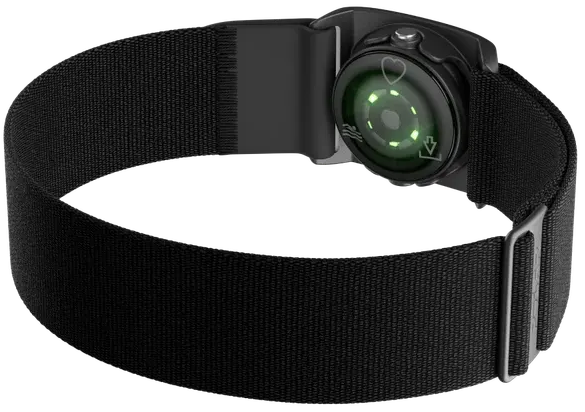
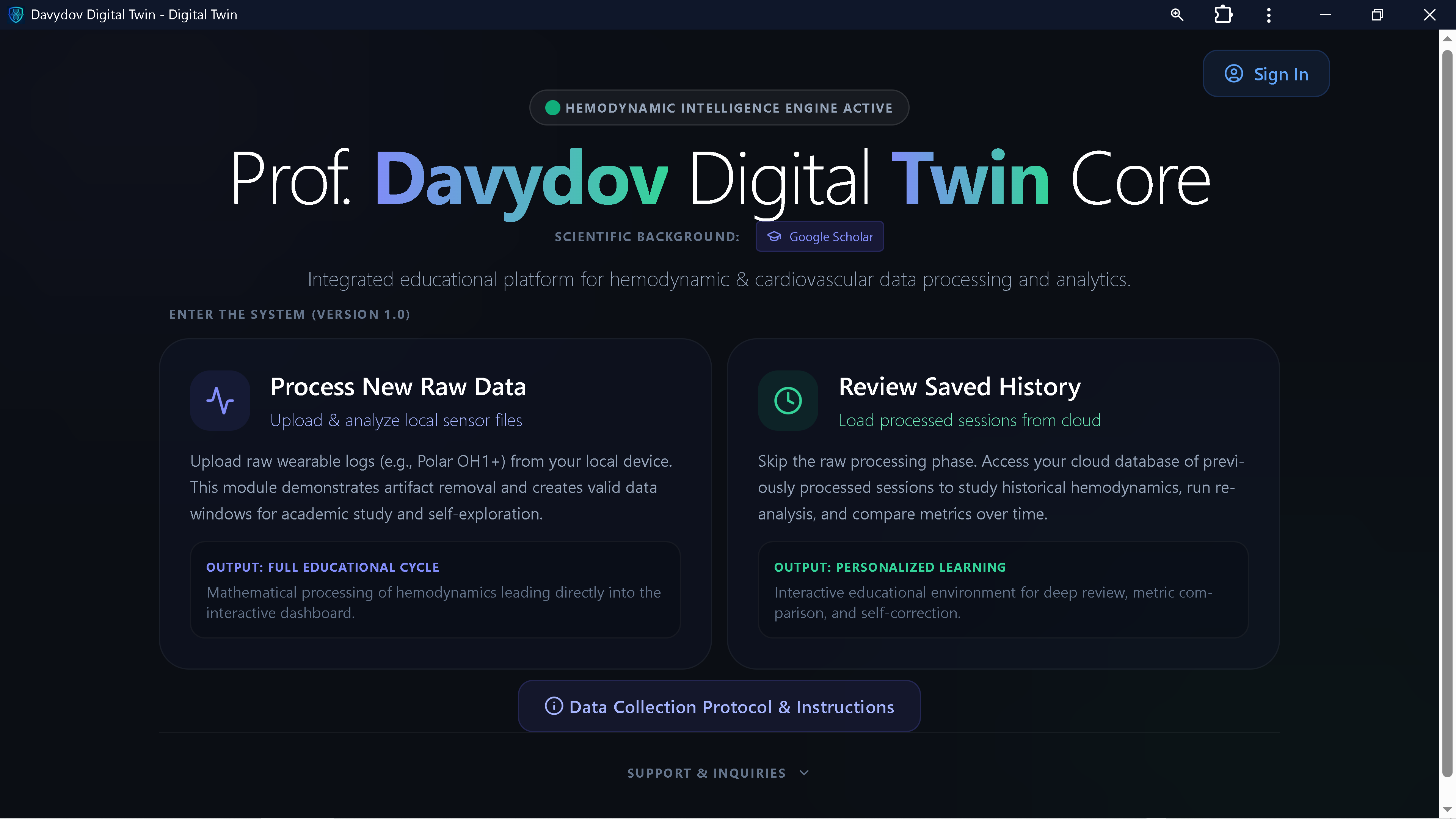
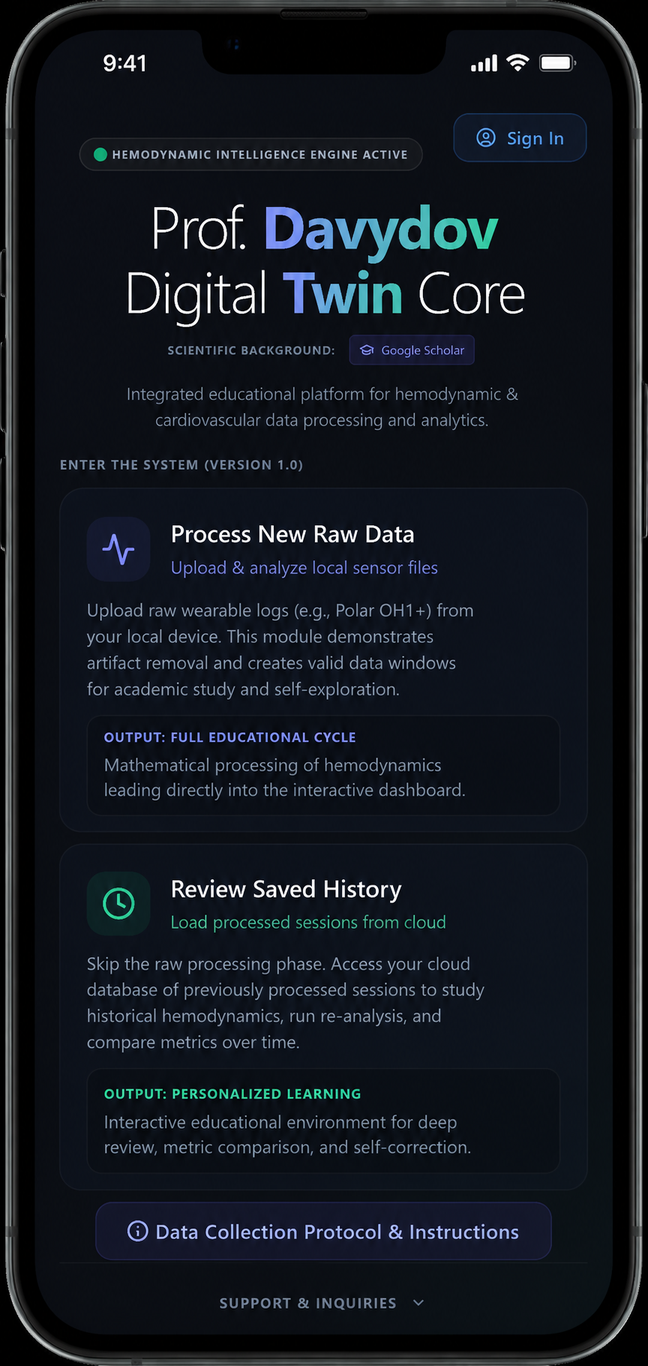
A third-party companion application designed for high-frequency raw optical signal streaming and local SDK dataset export (.csv format accepted).
Proprietary high-speed secure binary compilation optimized for continuous orthostatic perturbation protocols and NBI core transmission.
Targeted Deployment & Benchmarking
SaluTests is not designed for a conventional vendor procurement pathway. Where an innovation, R&D, or strategic partnership function exists, this is where we prefer to begin — exploring together how our physiological engine can create capabilities that conventional clinical measurements or traditional vital signs are not designed to resolve. Rather than extending the conceptual limitations of current clinical and consumer metrics, we are designed to work with innovation teams, strategic partners, and clinical leaders across wellness, advanced therapeutics, and elite human performance who are looking to introduce new physiological capabilities into their existing programs.
Extend your wellness, fitness, resort, coaching, or health-related services with our physiological phenotyping processor. Our architecture bypasses traditional hardware dependencies by offering a frictionless software overlay.
“Can this technology reveal actionable physiological heterogeneity that our current clinical measurements or vital signs cannot see?”
System Infrastructure Analogy:
The Data Bus (Sensor): Validated optical BLE hardware acts as a high-speed data bus, capturing raw physiological streams from peripheral tissue.
System Memory (Logger): The companion logging utility serves as the immutable system memory, precisely buffering high-frequency PPG datasets for secure SDK export.
Central Processor (SaluTests Core): Our neurosymbolic cloud engine operates as the central computing processor, transforming raw streams into individual, actionable digital twins (physiological phenotypes that can inform intervention selection).
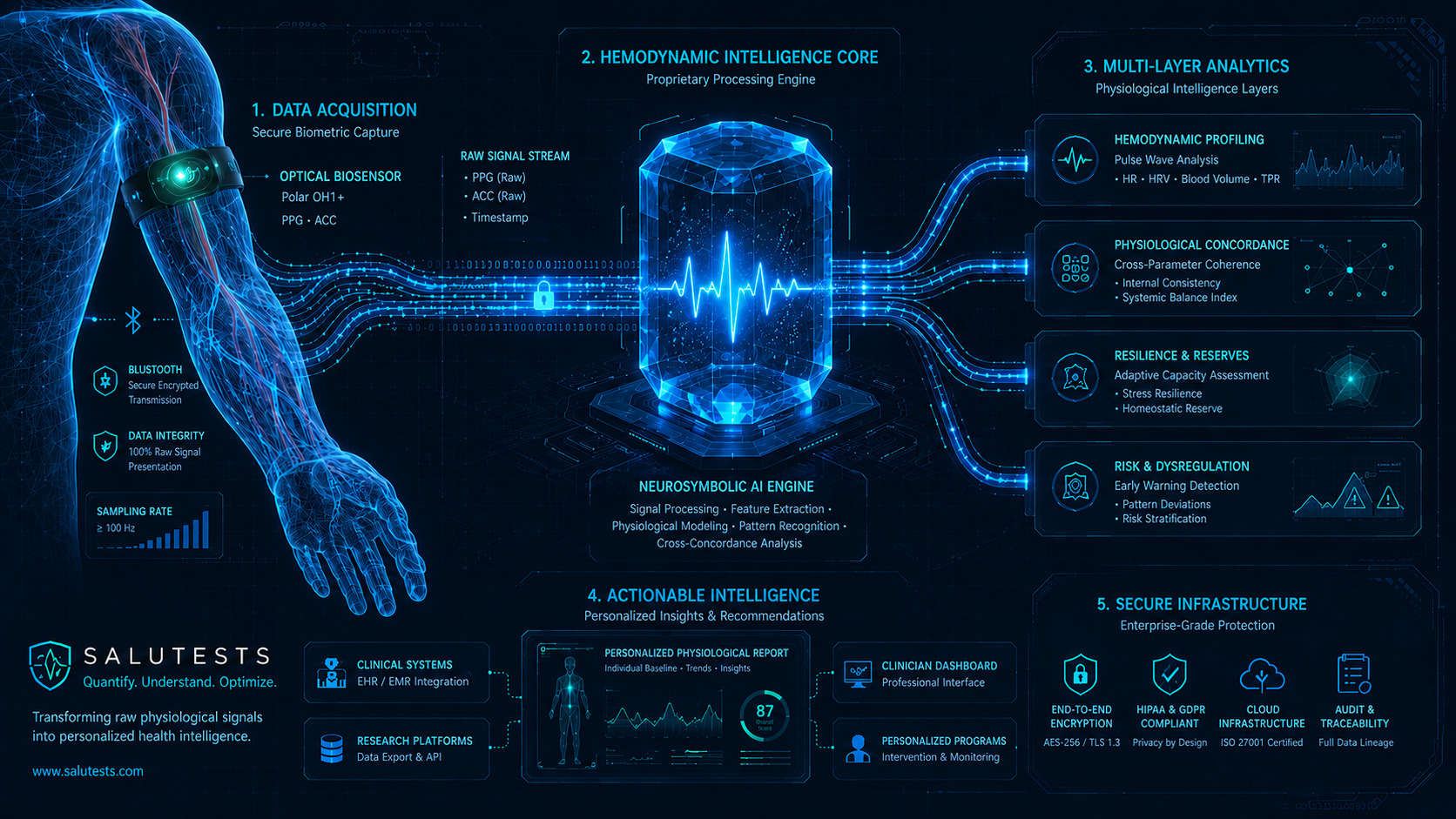
While legacy platforms merely track temporal fluctuations around relative population norms, SaluTests processes unaltered morphology to map a multi-dimensional, stable physiological phenotype sensitive to actual lifestyle interventions.
Conventional health and fitness metrics found in commercial trackers—such as stress scores, calorie estimates, or body-composition estimates—typically lack individual dynamic verification. Consequently, they provide limited information about the regulatory state of a specific individual and cannot, by themselves, reconstruct the physiological mechanisms underlying that state.
Beyond population-derived metrics — the illusion of physiologically meaningful measurement and knowledge:These standard tracking metrics can create an illusion of physiologically meaningful measurement and knowledge. More data does not necessarily produce more physiological knowledge. Consumer health platforms can generate thousands of measurements while remaining anchored to population-derived correlations and static proxies.Much like artificial sweeteners trick the organism into expecting an influx of energy while being metabolically and energetically empty, commercial tracker metrics provide a data-facade without individual physiological substance, replaced by an averaged, abstract person living in statistical, population-derived correlates.Many consumer metrics ultimately derive their interpretation from population-level models, normative assumptions, proprietary algorithms, or composite scores whose physiological meaning for a particular individual is not dynamically established.
Measurement Accuracy vs. Physiological Insight:A metric can be accurate without being physiologically informative, and measurement accuracy is not the same as physiological explanation.
Legacy consumer tracking models operate on averaged population templates, where raw biometric streams are aggressively smoothed to remove noise and artefacts. This protocol pushes static, descriptive scores (e.g., generic Sleep, Stressed, or Readiness percentages) based on brute-force statistical correlations, rendering the platform completely blind to the subject's genuine individual regulatory costs, reserves, and compensations.
Legacy models operate on static categorical classifications, where Diagnosis is established merely as the combination of clinical symptoms. This protocol tracks fixed aggregate endpoints only after an intervention has already occurred.
SaluTests takes a different approach: individual dynamic verification through physiological perturbation. Our neurosymbolic engine injects an immutable continuous observation layer, predicting the Individual Response Architecture—defined as the exact combination of actual physiological resilience reserves, compensations, and adaptations—mapping real-time regulatory feedback loops before inference or decisions lock in.
This architecture unlocks an entirely different product economics through advanced patient stratification, preventing clinical trial failures at late stages.
Single Syndrome Label / Unified Diagnosis
Discovery of Multiple Mechanistic Phenotypes
Identification of Differentiated Treatment Responses
Precise, Data-Driven Patient Stratification
This architecture unlocks an entirely different level of athletic longevity and structural safety through advanced physiological stratification, preventing acute musculoskeletal failures and soft tissue injuries at elite training stages.
Single Athletic Status Label / Unified Training Load
Traditional coaching metrics categorize athletes using fixed, aggregate endpoints (e.g., standard heart rate or heart rate variability zones, recovery percentages, or external power outputs) as if their internal physiological systems adapt symmetrically.
Discovery of Multiple Fluid & Autonomic Phenotypes
SaluTests isolates the hidden conflict between thermal regulation and fluid distribution. Our engine identifies distinct underlying phenotypes, revealing athletes who mask critical volume depletion and mesenteric vasoconstriction underneath a normal resting heart rate and heart rate variability.
Identification of Differentiated Soft Tissue Risks (Dry Fascia Trap)
The system detects when the physiological "orchestra" is forced into a competition for fluid. Under the illusion of a proper 'warm-up,' the body diverts interstitial fluid away from fascial sheets and tendon matrices to prioritize thermal sweating. This leaves the fascial architecture completely dry, stiff, and highly vulnerable to catastrophic muscle or ligament tears during explosive loads (a proposed physiological mechanism underlying the ‘False Warm-Up’ scenario).
Precise, Data-Driven Training Stratification & Load Vectoring
By determining the exact dynamic threshold of fluid-autonomic compromise, the platform issues a precise stratification. Coaches no longer push athletes blindly into injury traps; instead, the system shifts the load to safe vector boundaries, preserving the athlete's structural health and capital.
| Dimension | Consumer Trackers (Garmin / Fitbit) | Clinical Systems (Masimo / Academic) | SaluTests Framework |
|---|---|---|---|
| Hardware Layer | Wrist-worn commercial sensors | Expensive, heavy clinical hardware | Core engine: hardware-independent (Validated acquisition path: Polar raw PPG) |
| Noise Strategy | Aggressive digital smoothing (erases wave data) | Suppression / motion artifact rejection | Trusted Windows (Morphology-preserving signal processing) |
| Primary Output | Basic vitals, unverified calories, sleep estimation | Basic vitals, SpO₂, respiration rates | Vascular clamping, blood volume shifts, cardiac energy cost |
| Baseline Reference | Flawed aggregate population norms | Static laboratory point-in-time | Personalized dynamic auto-baseline |
| Scalability Cost | Low cost / Limited physiological depth | High CapEx, Operational complexity | Cloud-native software overlay / Low deployment friction |
Pulse of Innovation
Stay updated with regular insights and news on the concepts and technologies behind neurosymbolic hemodynamic modeling, clinical translation milestones, and physiological sovereignty.
Institutional Engagement
SaluTests integrates with premier wellness ecosystems, clinical research pipelines, and biohacking frameworks. We do not deploy off-the-shelf software; we embed a proprietary scientific engine tailored to your operational environment.
To protect mutual proprietary computational know-how and operational metrics, all institutional onboarding strictly follows a progressive validation path:
Detailed technical architecture, proprietary algorithms, and session data structures are disclosed exclusively within a secure legal framework to foster transparent technical alignment. Illustrative report structures and phenotype outputs are demonstrated during the partner-specific technical evaluation.
Initial evaluation proceeds via a metrics-driven data audit using anonymized parameters, ensuring the neurosymbolic core generates quantifiable asset value prior to deep platform integration.
Following validation, deployment shapes are structured dynamically around actual system usage: spanning per-session models, SaaS licensing, or deep white-label infrastructure embedding. Commercial structure is defined according to deployment scope, data volume, integration requirements and partnership model.